Abstract
The future of engineering isn’t writing code — it’s designing systems of intelligence that deliver outcomes.
Originally published on Medium on February 15, 2026
Scaling through hiring alone has limits. We’re used to being asked to do a bit more with less—delivering outsized outcomes. In that vein Satya Nadella, Microsoft CEO put it well:
“If you are in this room you need to deliver outsized success.
To do that you need to allocate resources ahead of conventional wisdom.
Conventional wisdom will generate conventional success and that won’t allow you to stay in this room.”
This pressure for outsized outcomes forces organizations to rethink how work is executed. AI has forced a new abstraction shift like high-level languages did for assembly languages, and frameworks did for those, as cloud did for those, and the agentic web continues. Organizational leaders must adapt or leave the room. It’s inevitable as execution costs collapse as competitive pressure increases.
Organizations can evolve as knowledge moves from people to systems and from systems to networks. How do we get there? By going beyond conventional wisdom alone.
Photo by Shubham Dhage on Unsplash
For many years, the Spotify model has given organizations seeking to scale, improve efficiency, and foster innovation, a useful mental shift: optimize for autonomy, not control. In the age of AI, autonomy extends even further with the introduction of agentic cliques.
In essence, this has meant shifting from command and control structures to an operating model focused on freedom, responsibility, and autonomy.
Engineering at scale is about making decisions where the context lives. Conway’s Law explains why: organizations naturally produce systems that mirror their communication structures, making decision proximity essential.
A Human Model
The Spotify model gave companies a great start, a framework that they and others could continue to evolve and adapt to their own company needs, culture, and strategic plans. Distilled, it defined Squads, Tribes, Chapters, Guilds, and later Missions:
Squad
A squad is the smallest unit of the organization, typically functioning as a cross-functional engineering team. Initially designed to feel like mini-startups, squads are highly self-organized and empowered to design, prototype, test, code, and deploy features independently. They often consist of a mixture of specialists e.g. backend engineers, web engineers, and other specialists to ensure they can deliver end-to-end functionality with minimal (but ideally, without) external dependencies.
Tribe
A tribe is a larger organizational unit, essentially acting as a department or division that unites and aligns several squads working in a related functional area or domain.
Tribes balance autonomy with consistency: preserving the independence of squads while ensuring their work contributes to a coherent system, sustainable organizational direction, and align on strategic bets. In large-scale engineering environments, the tribe becomes the primary unit for managing complexity, reducing coordination costs, and enabling multiple teams to move quickly without creating systemic risk.
Chapters, Guilds, Missions
Chapters were usually small groups of people with similar skills e.g. backend engineers, etc. across different squads. They have generally fallen out of favor but guilds—wide communities of practice / interest that anyone can join to share knowledge, provide mutual help, and network, still remain popular.
A mission is an organizational unit representing a major business area, usually sitting at the top of the organization, uniting several tribes and helping to set strategy and coordinate on company bets.
Press enter or click to view image in full size
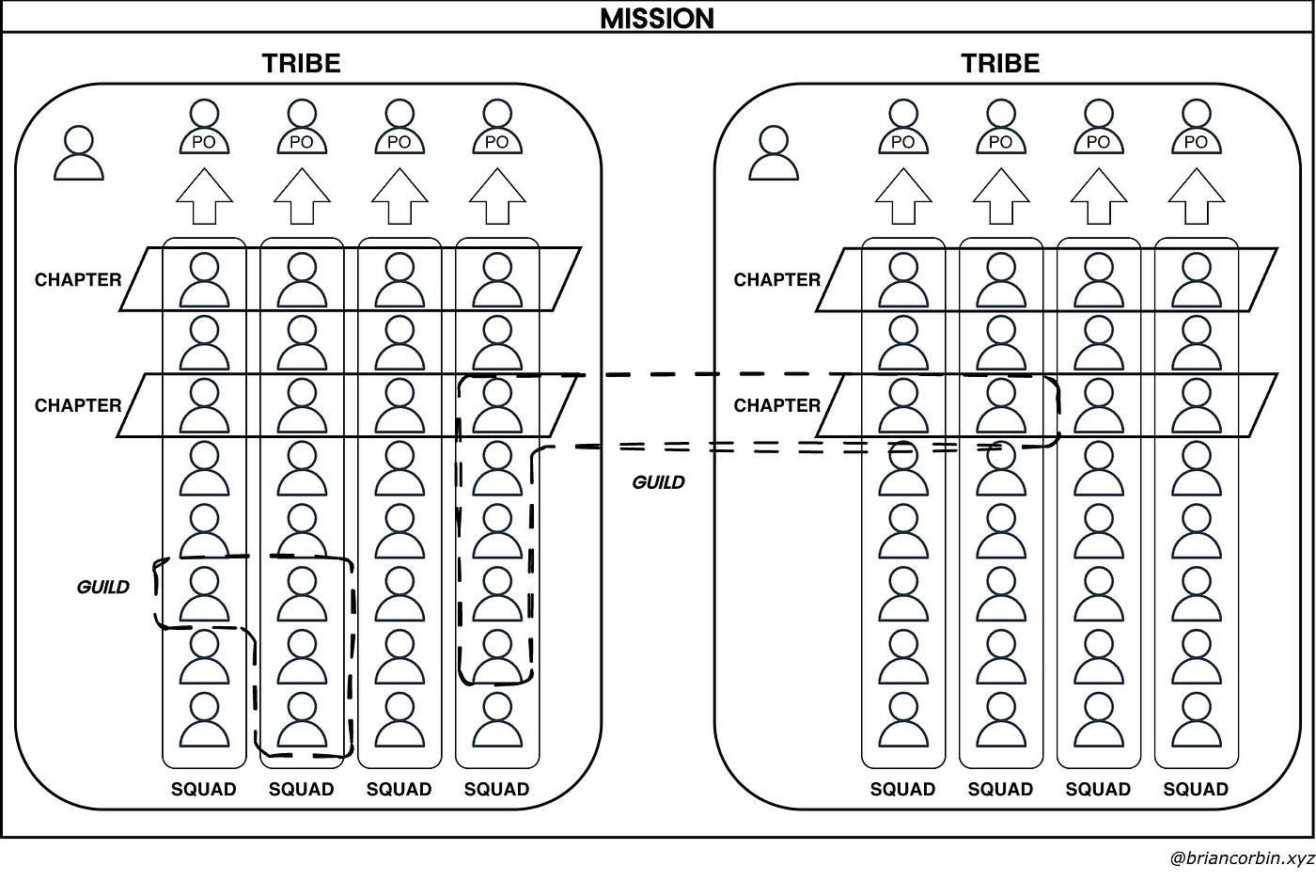
Engineering at Scale: Scaling Agile w. the Spotify Model
Tribes and squads aren’t special because of ceremonies or titles, neither are they a simple relabeling of the old command and control teams. They work because they reduce the cost of coordination and complexity. They move decisions closer to the context. Trust replaces long approval chains. Colocation reduces friction.
Now AI is forcing us to learn the same lessons all over again but this time, much faster. This model solved coordination for human teams by organizing humans around context. The next challenge is coordinating intelligence itself with that lesson now learned. If the Spotify model organized humans around context, the next evolution organizes intelligence around context.
That happens as knowledge moves from people to systems and from systems to networks
An Agentic Model
Every truly meaningful increase in scale comes from reducing the cost of coordination. Squads reduced coordination cost for humans; agentic systems do the same for digital work.
Caution is necessary here: attempting to “skip to the end” imagining that “the end” comes without human accountability continues to prove to be unrealistic. Moving too fast, too far, too soon will lead to costly rollbacks. Similarly unrealistic or even unforgivable is inertia when it comes to modernizing our engineering practices—adopting agentic tools is a must in any organization that wants to continue to innovate, scale, and meet the speed of progress.
A phased, empathetic rollout of agentic tooling isn’t just a recommendation — it’s the only sustainable way to modernize without losing human accountability or sacrificing autonomy.
Trust in agentic systems must be earned, not imposed. Careful, deliberate steps are required for employees to develop sympathy—a mental model of system behavior and the kind of practical understanding required for skillful use—for the agentic tools they are asked to work alongside. This is what makes engineering at scale possible.
Organizations can purposefully adopt agentic tools whilst assessing their maturity at various stages. At each stage we must improve trust, increase knowledge capture, reduce risk, and establish organizational readiness through learning.
Pre-Crawl
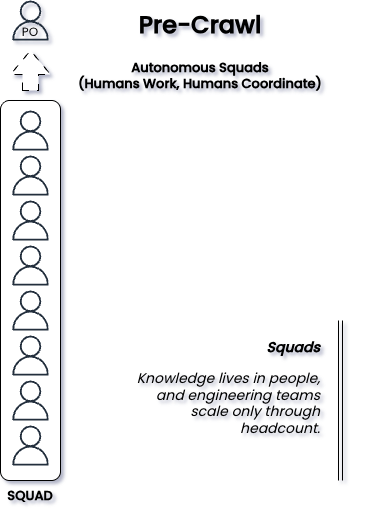
Work is human-driven.
Knowledge lives in people.
Teams scale through coordination.Engineering evolves as knowledge moves from people → systems → networks
Human coordination scales slowly. When execution pressure increases, organizations reach for tools that amplify individual productivity. This is where AI first enters the picture.
Crawl
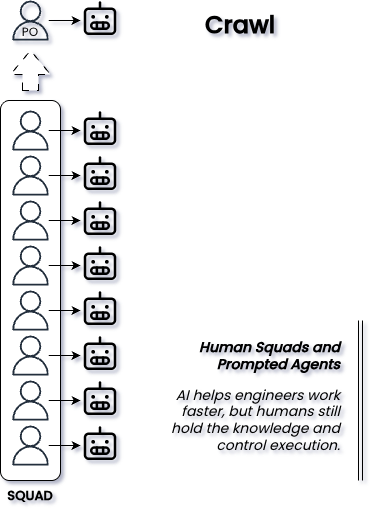
AI accelerates execution.
Knowledge still lives in people.
Engineers supervise tools.
Productivity gains from prompting alone plateau quickly. To scale consistently, organizations must move beyond ad-hoc usage and begin codifying knowledge into reusable capabilities and skills.
Walk
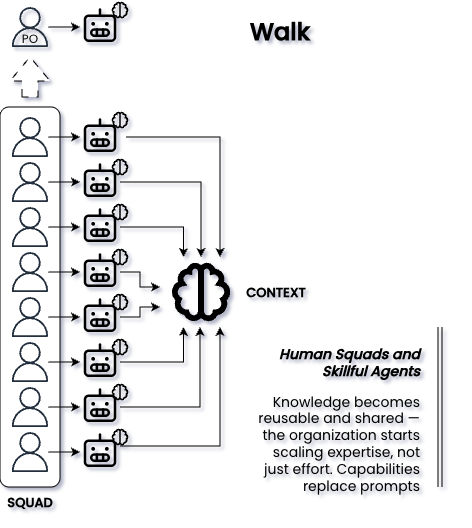
Knowledge becomes reusable.
Expertise is encoded as capabilities.
The organization begins to scale intelligence.
Once knowledge is encoded, execution can be delegated. The challenge shifts from doing work to orchestrating systems that do it.
Run
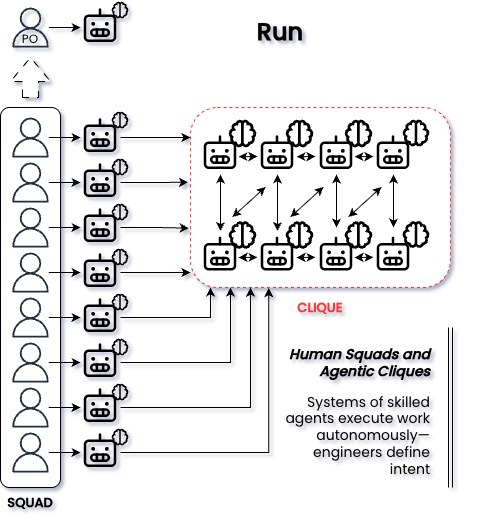
Systems execute work autonomously.
Knowledge drives coordinated action.
Engineers design intent and constraints.
Having seen how organizations crawl, walk, and run, the question becomes: what happens at scale?
The shift toward agentic organizations does not eliminate engineers. It elevates them. As execution becomes cheaper and increasingly autonomous, the scarce skill is no longer writing code, but designing systems of intelligence that deliver outcomes. Engineers become system designers. Leads govern intelligence. Organizations move from coordinating people to orchestrating networks of capability.
This is not a replacement of human expertise, but its amplification. Knowledge that once lived in individuals becomes encoded in systems. Decisions move closer to where context lives. Execution scales beyond human bandwidth. What emerges is an organization that can learn, adapt, and act with unprecedented speed.
The future of engineering is therefore not less engineering, but a broader definition of it: one grounded in judgment, domain understanding, and the careful design of intelligent systems. The teams that thrive will not simply adopt new tools, but rethink how work itself is structured.
The Spotify model showed how to organize humans for autonomy. The next evolution organizes intelligence itself. How organizations make that transition — deliberately, empathetically, and with clear maturity — will define the next era of engineering at scale.
Next
This series examines engineering at scale across three layers — technical, organizational, and agentic — unified by a single idea: performance at scale is always about getting decisions closer to where the context lives. At the systems level, that means eliminating the distance between data and the hardware that moves it. The same principle, it turns out, applies everywhere.
- Comment your own opinions about engineering at scale.
- Follow my blog (or sympathetic engineering digital garden) for future updates on my sympathetic engineering exploits and professional / personal development tips.
- Connect with @briancorbinxyz on social media channels.
- Enjoyed what you read? I like coffee, buy me a coffee so I have an excuse to write more.